Types of website development, explained
“Website development” covers everything from a one-page site to a full SaaS platform. Here are the main types - by developer role and by website type - so you can name exactly what your project needs and hire the right skills.
When people say they need “website development,” they can mean wildly different things - a five-page brochure site and a real-time SaaS dashboard are both “websites,” but they need almost opposite skills. Knowing the types of website development helps you scope your project accurately and avoid paying for the wrong kind of build.
We’re Web{X}, and we build across all of these types. Here’s the clear map - first by developer role, then by the kind of website itself.
By role: the three core types
Front-end development
Front-end (or “client-side”) development builds everything the visitor sees and interacts with: layout, navigation, buttons, forms and animation. It uses HTML, CSS and JavaScript, usually with frameworks like React or Next.js. Strong front-end work is what makes a site feel fast, polished and effortless on every screen.
Back-end development
Back-end (or “server-side”) development builds the invisible engine: servers, databases, authentication, payments and business logic. It uses languages such as Node.js, PHP or Python with databases like PostgreSQL or MongoDB. The more your site processes - orders, users, data - the more back-end it needs.
Full-stack development
Full-stack developers work across both front-end and back-end. Most serious projects need this breadth, which is why a studio team - combining design, front-end and back-end skills - usually beats a single specialist for anything beyond the simplest site.
By website type: what you’re actually building
Beyond roles, development also differs by the kind of website:
| Type | What it is | Best for |
|---|---|---|
| Static website | Fixed pages, no database | Simple brochures, portfolios, docs |
| Dynamic / CMS site | Content pulled from a database/CMS | Blogs, marketing sites, most businesses |
| Ecommerce | Catalogue, cart, payments | Online stores, D2C brands |
| Web application | Logins, dashboards, real-time data | SaaS, portals, internal tools |
| Headless / Jamstack | Decoupled front-end + API/CMS | Performance-critical, scalable sites |
Not sure which type you need?
Tell us what your website has to do and we’ll recommend the right build - static, CMS, ecommerce or web app - and quote it clearly within two business days.
Get advice & a quoteStatic vs dynamic: the key split
A static site serves the same fixed pages to everyone - fast, secure and cheap, ideal for content that rarely changes. A dynamic site builds pages on the fly from a database or CMS, so content can be updated without touching code. Most business websites today are dynamic (or a modern hybrid via Jamstack), because owners want to edit their own content.
Custom code vs no-code - a cross-cutting choice
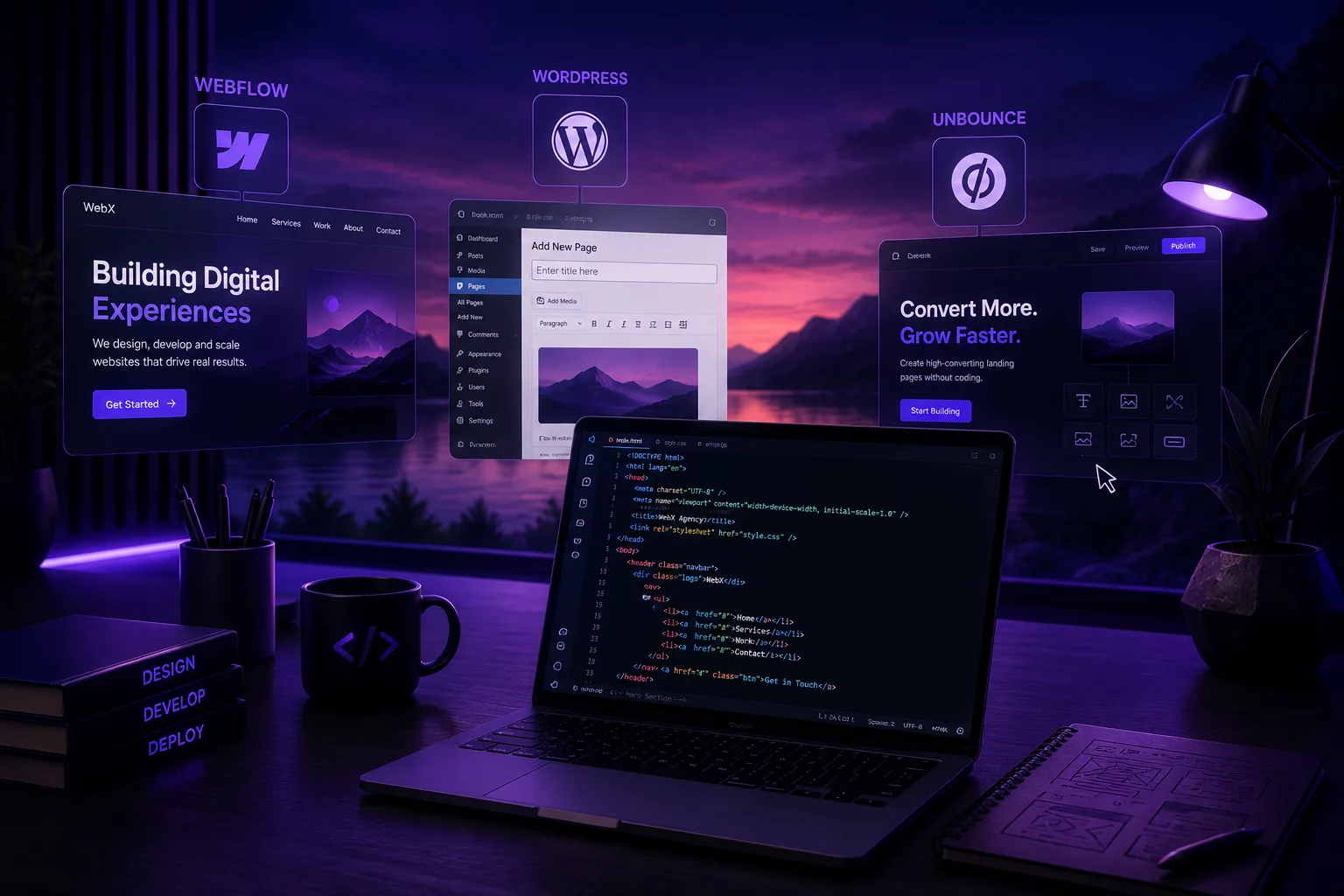
Any of these types can be built with hand-written custom code or on a visual platform like Webflow, Framer or WordPress. No-code is now genuinely powerful for marketing sites, blogs and lighter ecommerce; custom code still wins for complex web apps. We compare the two in custom development vs website builders.
Pick the type of development from what your site must do - not from a technology you happen to have heard of.
Which type does your project need?
- Marketing / brochure site? A dynamic CMS site (often no-code) - fast to build, easy to edit.
- Online store? Ecommerce development on Shopify or a custom stack.
- Product with logins & data? Web app / full-stack development.
- Content-heavy & performance-critical? Headless / Jamstack.
Naming the right type early is half the battle - it sets the skills, the timeline and the budget. Get it right and you hire the correct team once, instead of rebuilding later. For the bigger picture, start with what website development is and how the process runs.